Interfacial Chemistries of Metal-Sulfur Batteries

Metal-sulfur batteries are deemed to be the most promising alternative for the next generation energy storage technologies. However, the formidable challenges such as dissolution of poly-sulfides into the electrolyte leading to the “shuttle effect” and sluggish reaction kinetics thwarting their practical realization. We employ first-principles density functional theory (DFT) calculations to design single-atom catalysts (SACs) -based anchoring materials and to understand the mechanistic details of the heterogeneous catalysis at the cathode-electrolyte interfacial chemistries. Additionally, we focus on designing novel additives for the metal-sulfur batteries and elucidate the mechanisms of homogeneous catalysis to impede polysulfides dissolution and expedite polysulfides conversion kinetics.
Related Publications
[Li/Na-S] ACS Catalysis, 2022, 12, 7664–7676 [Link]
[Na-S] ACS Applied Materials and Interfaces, 2022, 14, 8, 10298-10307 [Link]
[Li-S] ACS Applied Materials and Interfaces, 2022, 14, 21, 24486–24496[Link]
[Na-S] ACS Catalysis 2021, 11, 24, 15149–15161 [Link]
[Na-S] ACS Applied Materials and Interfaces, 2021, 13, 30, 35848–35855 [Link]
[Na-S] Journal of Physical Chemistry C (2021)2021, 125, 8, 4458-4467[Link]
[Li-Se] Nanoscale, 2020, 2020 , 12 (26), 14087–14095 [Link]
[Li-S] Journal of Physical Chemistry C J. Phys. Chem. C 2020 , 124 (50), 27323–27332.[Link]
Electrification of Chemical Synthesis to reduce carbon-footprint
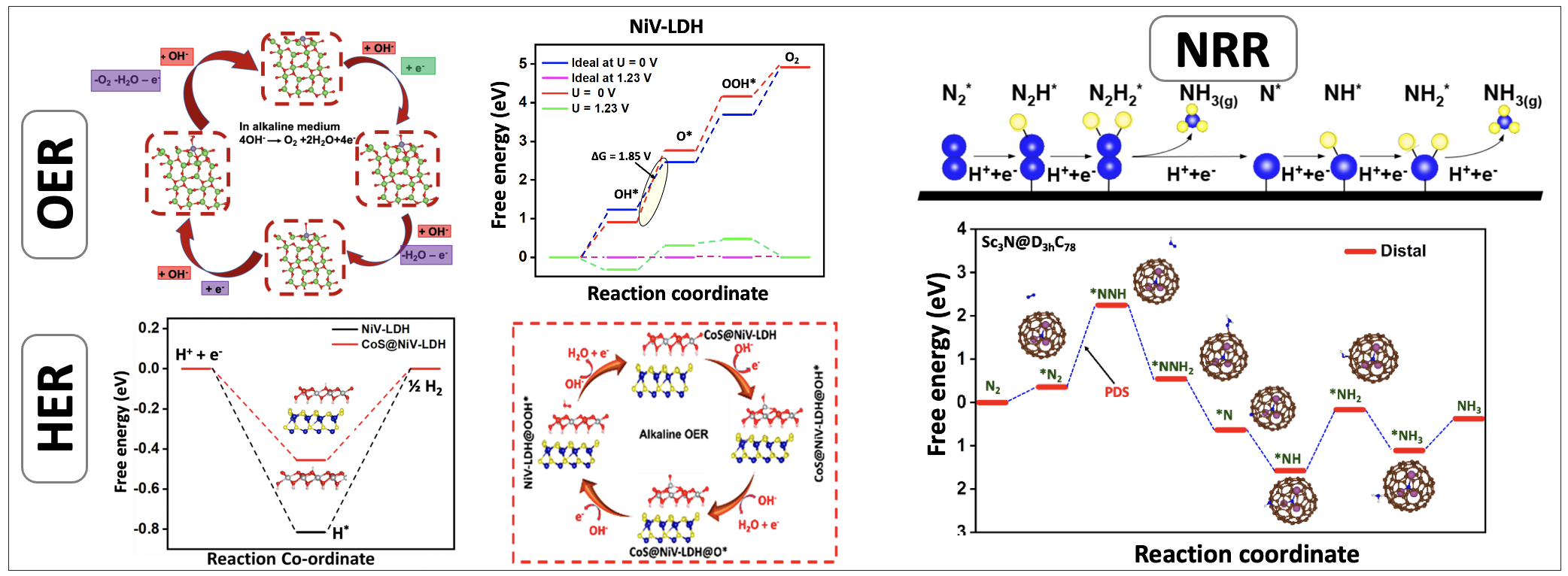
Reduction of carbon footprint is a major global driver motivating the energy transition from the fossil fuel to cleaner alternatives. Furthermore, decarbonization of the chemical production is a critical need to mitigate the global warming. The availability of electricity from renewable sources at a cheaper cost is stimulating research on synthesis of ammonia, CO2 reduction to useful chemicals or water splitting to produce hydrogen and oxygen through electrochemical processes. Designing efficient electrocatalyst is in central focus to make these novel electrocatalytic systems practically feasible. In order to undertake the challenges, we leverage first-principles density functional theory (DFT) simulations to design electrocatalysts and develop atomic-level insights of the underlying chemical processes.
Related Publications
[OER] J. Mat. Chem A., 2023, 11, 10684-10698 [Link]
[OER] ACS Appl. Mater. Interfaces ,2023, 15, 22, 26928–26938 [Link]
[OER] Small., 2022, 20, 2202648 [Link]
[OER] ACS Sustainable Chem. Eng. 2022, 10, 34, 11299–11309 [Link]
Interfacial Chemistry of Lithium-ion Batteries

We developed a computational tool, eReaxFF, for simulating explicit electrons within the framework of the standard ReaxFF reactive force field method. We treat electrons explicitly in a pseudoclassical manner that enables
simulation several orders of magnitude faster than quantum chemistry methods, while retaining the ReaxFF transferability. we employed eReaxFF method to investigate the major reduction reaction pathways of solid electrolyte interphase (SEI) formation with ethylene carbonate (EC) based electrolytes. Our eReaxFF-predicted results for the
EC decomposition reactions are in good agreement with the quantum chemistry data available in the literature. Our molecular dynamics (MD) simulations capture the mechanism of the reduction of the EC molecule due to electron transfer from lithium, ring opening of EC to generate EC−/Li+ radicals, and subsequent radical termination reactions.
Related Publications
J. Chem. Theory Comput. 2016, 12, 8, 3463–3472 [Link]
J. Phys. Chem. C 2016, 120, 48, 27128–27134 [Link]
Interfacial Chemistry of Solid State Lithium Batteries
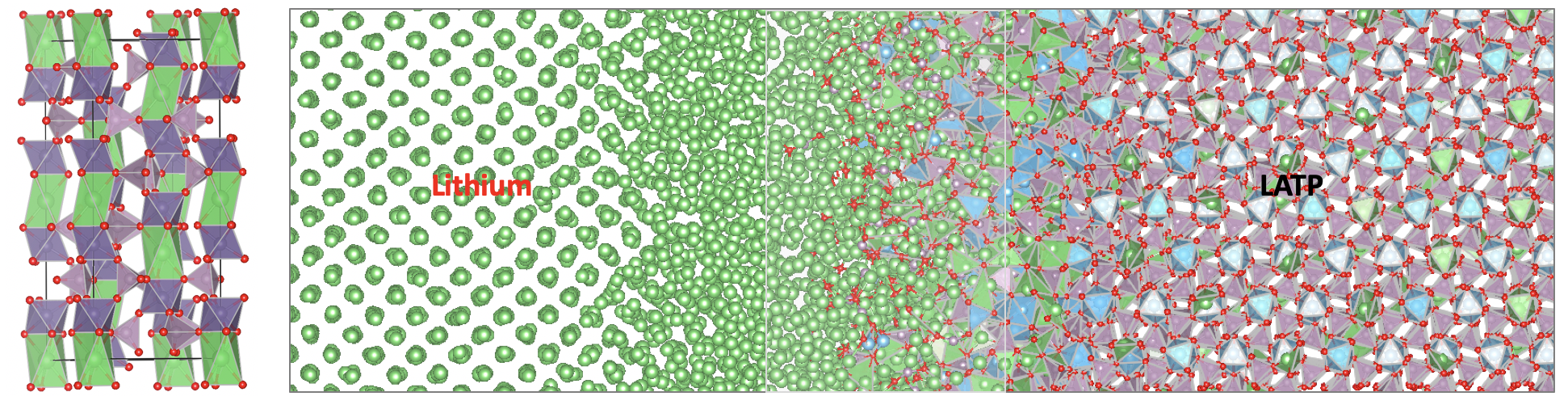
Solid-state batteries (SSB) are safer and have higher energy density than conventional Li-ion batteries. However, high impedance and chemical reaction induced phase change at interfaces between solid-state electrolytes and electrode materials limit SSB performance. We are working on understanding the evolution of interfaces between electrodes and solid electrolyte materials in solid-state batteries using first principles based quantum chemistry and eReaxFF molecular dynamics simulation techniques.
Physics and Chemistry of Energetic Materials at Extreme Conditions
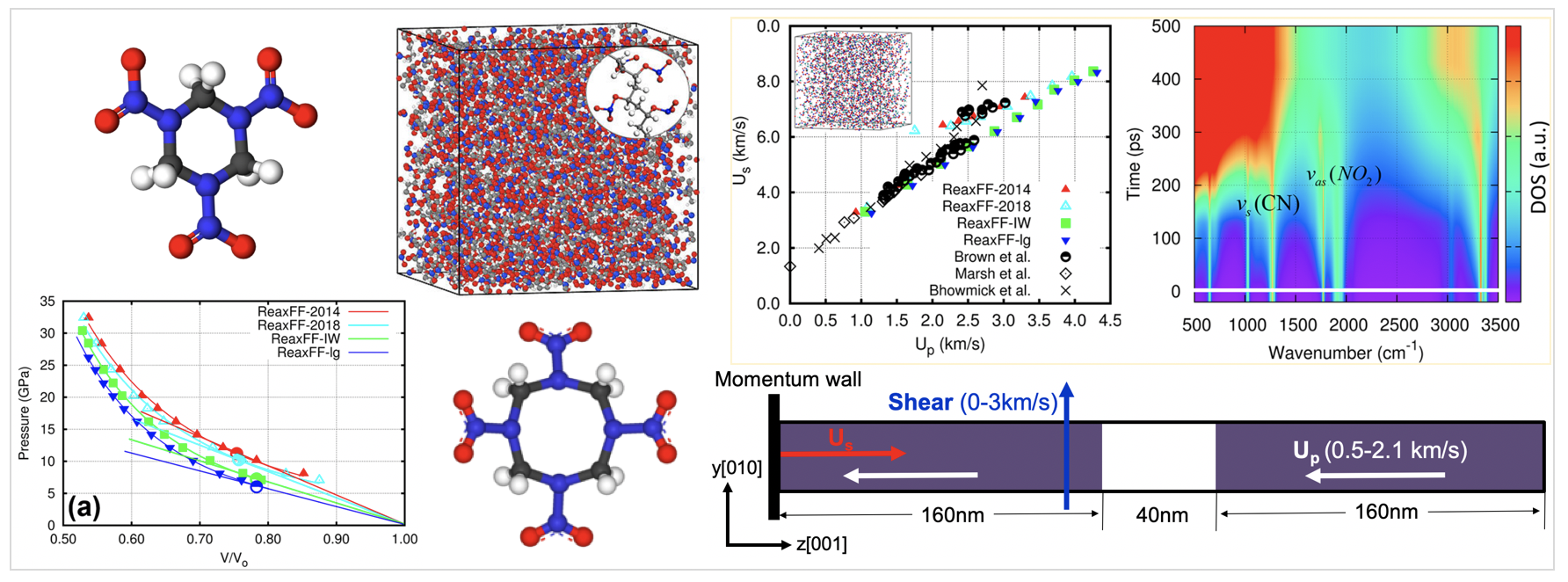
A detailed understanding of the mechanical and chemical response of high energy (HE) materials to shock loading is crucial to evaluate their performance and safety. When HE materials are subjected to strong mechanical shocks, they undergo complex chemical and physical processes that can eventually lead to detonation. We use molecular dynamics (MD) simulations with the ReaxFF reactive force field to investigate the
thermomechanical, chemical, and spectroscopic response of a wide range of high-energy materials such as RDX, HMX, TATB, TNT, Polyvinyl Nitrate, and Nitromethane to shock loading.
Related Publications
J. of Appl. Phys, 2023, 133, 085101 [Link]
npj Comput Mater, 2021, 7, 9 [Link]
J. Phys. Chem. A 2021, 125, 7, 1447–1460 [Link]
J. Phys. Chem. A 2020, 124, 44, 9141–9155 [Link]
J. of Appl. Phys., 2020, 128 (6), 065101 [Link]
J. Phys. Chem. C 2018, 122, 47, 27032–27043 [Link]
J. Phys. Chem. C 2017, 121, 40, 22452–22464 [Link]
J. Phys. Chem. C 2017, 121, 40, 22452–22464 [Link]